
Helping hospitals get
paid more, faster.
Medical coding & claim financing for
Indonesia's $1.3B medical receivables market.
Medical coding & claim financing for
Indonesia's $1.3B medical receivables market.
Problem
~$1.3B
in receivables
Across Indonesian hospitals, with 70% owed by insurance, mostly BPJS.
40%
delayed over 30 days
Across Indonesian hospitals, with 70% owed by insurance, mostly BPJS.
8–12%
bad debt
On total annual revenue.
Sources: Kemenkes 2022 (hospital receivables); 2023 sectoral survey (claim delays, bad debt); MedMinutes / Kemenkes 2026 (pending claims).
Why now
All-new 7-digit codes. 5 severity tiers. 1,300 groups. 22,000 diagnoses.
Tier 2 & 3 hospitals struggle to staff coders.
Every existing AI claim-audit tool in Indonesia was trained on INA-CBG.
They are retrofitting while we are building iDRG-native.
Solution
Empowered with AI Assistant
iDRG-native
AI-Underwriting
Shariah-Compatible
Just connect the clinical notes. Our team gets them paid.
Architecture
1
Large language model
Clinical notes are unstructured Bahasa Indonesia prose. LLMs are the only practical way to extract diagnosis, procedures, severity, and length of stay into a structured representation that downstream models can reason over.
2
Retrieval + re-ranking
iDRG has ~22,000 diagnoses across ~1,300 groups — too large a vocabulary for any single model to select reliably. Vector retrieval narrows candidates; a re-ranker trained on real claims picks the final code with rationale a coder can audit.
3
Bayesian net + gradient boosting
Bayesian priors encode clinical reasoning a doctor recognizes and can edit. Gradient boosting layers in empirical patterns from historical claims. Output is a calibrated probability of approval — not a confidence rank.
4
Calibrated credit model
Combines rejection probability with hospital-level history and claim features into an advance rate. Conservative by default — calibration error here is direct loan-book risk for the bank partner.
Specialized models compose into one verdict — and one advance rate.
Business model
Four engagement depths. One AI platform. One outcome.
01
The wedge
We work your rejected and aging BPJS claims back into approved, paid claims.
Pricing
20–50% of recovered value
Pure contingency. No upfront fee.
Found money
02
SaaS co-pilot
Your coders work in our iDRG-native AI platform — gap detection, queries, pre-submission validation.
Pricing
Per-bed monthly or per-claim
Low monthly floor. Unlimited users.
Productivity
03
Coding-as-a-service
Our trained coders run your full workflow on our AI. We deliver submission-ready claims in 48 hours.
Pricing
Rp 15–25K per claim
Or monthly retainer by volume.
Capacity
04
Outcome-priced BPO
Operate plus a contractual floor on your realization rate. We make you whole on shortfalls.
Pricing
1.5% baseline + gainshare
95%+ guaranteed approval rate.
Outcomes
+ Claim Financing
Layered across all four — 90–97% advance within 48 hours, sharia-compliant (DSN-MUI Fatwa 67/2008).
Market
TAM
Indonesian hospital claim infrastructure
Rp 23.0T
$1.5B USD
3,000 hospitals · all insurance-owed receivables outstanding
SAM
Sharia-aligned hospital networks
Rp 2.7T
$154.0M USD
~500 hospitals · Muhammadiyah, NU, Aisyiyah, RS Islam
SOM
3-year capture from Muhammadiyah beachhead
Rp 250B
$15.4M USD
120 hospitals in founder network · 80–100 paying by year 3
Tier-B/C hospitals book Rp 5–15B/month in BPJS claims. We start where the relationships already exist.
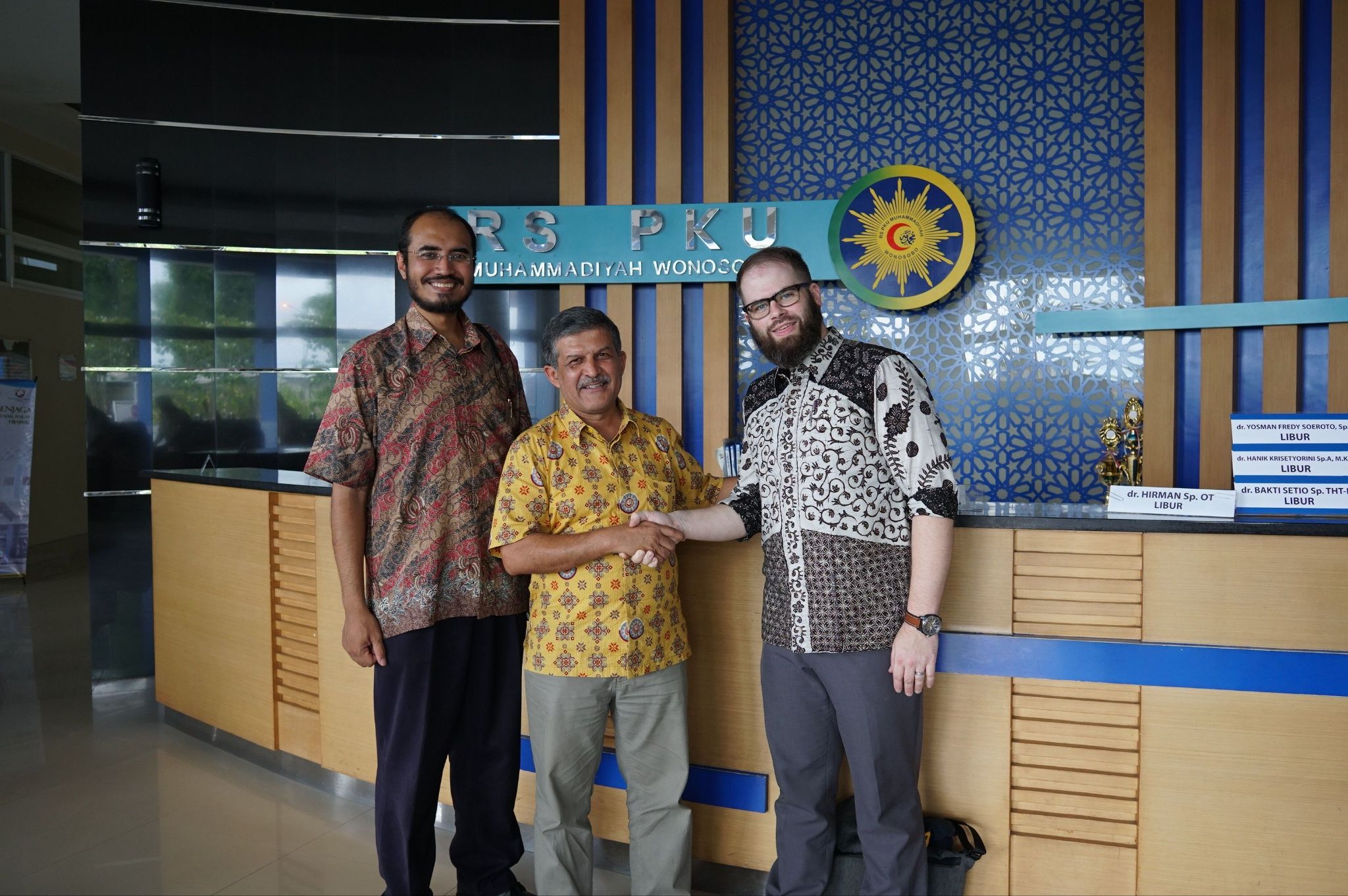
About the founder
Go-to-market
Months 0–6
Sign MPKU as institutional partner. Pilot 3–5 flagship hospitals: RS PKU Muhammadiyah Yogyakarta, RS PKU Surakarta, RSI Aisyiyah Malang.
Months 6–12
First paid software contracts. Lock bank channelling partnership — BSI lead, BTM/BPRS for local distribution.
Months 12–18
Live financing at 5 hospitals. Sign 30+ more Muhammadiyah hospitals on software.
Months 18+
Extend to NU / Aisyiyah / RS Islam networks. Then conventional hospitals.
Competitors
Value delivered
Engagement model
Software Vendor
Operating Partner
Turning Claims into Cash
Cleaner Claims Submission
Operating partner · cash in 48h
Software vendor · broader workflow
Software vendor · claim audit
The ask
Raising
Incubator + F&F + Angel
As SAFE